|
No. 8
Donnerstag, 13. November 2025
|
|
The Intermediality Messenger: Newsletter of the Centre for Intermediality Studies in Graz (CIMIG)
Fall/Winter 2025
|
Dear Subscribers:
In this issue, you will find news about CIMIG events this fall, about goings-on in Graz that invite intermedial perspectives, about recent publications, and other tidbits.
We are happy to report that we have a new CIMIG colleague: Anna Lorenzon, who holds a Master’s degree in English and American Studies from the Universities of Venice and Graz, started working at the center in September. She was also admitted to the University of Graz as a PhD student in English and American Studies. Welcome, Anna!
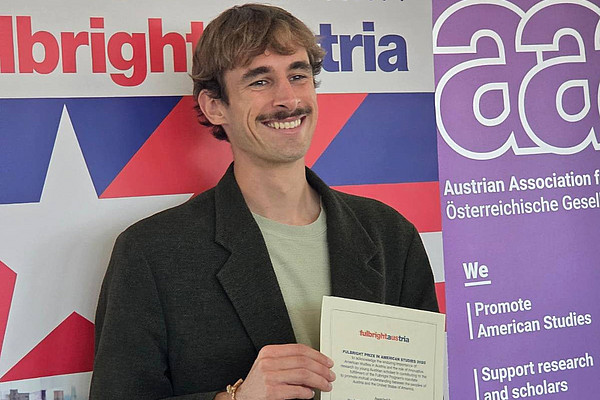
Michael Meister, who worked at CIMIG as a research assistant from March 2023 through September 2024 and who helped launch this newsletter in 2023, received the annual Fulbright American Studies Award 2025 for his MA thesis on “Intermedial Ecopoetry as Monumental Writer-Activism – Witnessing Slow Violence and Apprehending the Anthropocene in Craig Santos Perez's Habitat Threshold.” We hope to see his thesis in print—maybe in the form of several articles or as a monograph. Congratulations, Michael!
As always, please feel free to send us questions or other input at cimig@uni-graz.at
|
Intermediality in the Classroom
Classes eligible for the certificate in intermediality this semester are: For a list of MA- and PhD-level classes offered by the Departments of American Studies, English Studies, Arts and Musicology, Romance Studies, and Slavic Studies, all of which contain intermediality-related components, click here.
|
|
|
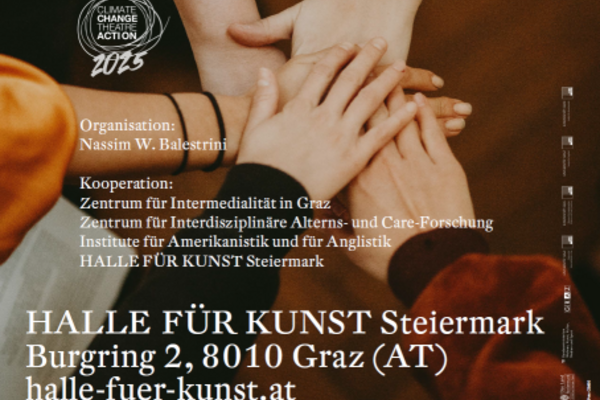
The sixth Climate Change Theatre Action festival is currently going on all over the globe, attracting audiences with its theme “The Time Is Now.” CIMIG will host an event entitled “NOW—AT ONCE—(AS OF) TODAY” at Halle für Kunst Steiermark on December 3 (5–6:30 p.m.). Nestled in the atmospherically expressive and spatiality-focused visual artworks of Argentinian artist Celine Eceiza, students from a drama and theater seminar (taught at the Department of American Studies) will recite several short plays and will invite audience members to engage in a discussion of the affordances and potential impacts of theater in public discourse on matters related to climate change. For further information, see our website and our Instagram-account. (NB)
|
Bookshelf Offering
Shah, Ashumi. The Mediaverse and Speculative Fiction Television: Understanding Speculative TV Fandoms (Springer Nature, 2024)
In this monograph, Ashumi Shah applies an intermedial approach to understanding speculative fiction television shows mainly from the 2010s (such as Star Trek, Black Mirror, The OA and Good Omens) and their respective fandoms as a relatively recent development in the media consumer dynamic. Shah posits that Mediaverse studies will eventually offer holistic toolkits which use “transmediality and intermediality to contextualise the texts in the current social, political and cultural climate” (9). Discussing the overlap of media forms and the migratory behavior of audiences from one text or medium to another and analyzing how this has been exacerbated by digital communication, Shah understands the mediaverse as containing all possible engagements associated with a particular text and which exists as a self-contained unit or pocket universe which stands alongside other such media-text universes (6).
According to Shah, the study of mediaverses supplements and combines media-centric, text-centric, audience-centric, and production-centric approaches through concepts such as feedback loops, transmedia, presumption, bricolage, and the like. Of particular interest in her monograph is the prosumer focus on the fandoms of speculative fiction TV shows, or what Shah calls the “fan-text-producer interaction” (1) in the online world. Highlighting how audience critique and consumption choices can influence further production in contemporary TV shows, and how media create social networks and communities, Shah takes an optimistic stance regarding the internet as creating alternate imagined communities (12). To focus on specifically speculative TV shows and fandoms was a fitting choice by Shah, as speculative media explicitly extend an invitation for audiences to postulate and activate their creative and imaginative capabilities, which might be a reason audiences and fans of such a genre are more inclined to be active in fandoms and have a greater sense of play. Following an introductory section on the Mediaverse and the specific TV shows used as examples, individual chapters are dedicated to the analysis of each show through the employment of the Mediaverse toolkit.
As this monograph proposes that the mediaverse “focuses on media divergence as opposed to convergence” (238), it invites intermediality and transmediality scholarship that can address the “proliferation of media phenomena or texts” (238) that the author describes, in closing, as posing a danger to as broad a concept as her notion of the mediaverse. More research that will demonstrate the fruitfulness of complementary approaches remains a desideratum. (LN)
|
Intermediality Around Town
Unseen Futures to Come. Fall – September 18, 2025–February 15, 2026 – Kunsthaus Graz, Space02
A library devoted to the concept of autumn/fall which has been set up and put in dialogue with selected artistic positions: This exhibition has been based on philosopher Federico Campagna’s concept of the library being a cyclical representation of the year, explaining how we comprehend the world and how our perceptions of our reality change over time. Specifically autumn is a time of disintegration during which the fear of decomposition leads to a loosening grip on one’s beliefs and certainties; the exhibition utilises this time of (productive) questioning, the natural changing of realities through time. There are twelve installations which comprise the exhibition, spanning photography, video and sound installations, textile work, oil painting, sculpture, and mixed media installations. The artists include Dana Awartani, Federico Campagna, Christoph Grill, Adelita Husni, Marija Marković, Vladimir Nikolić, Yhonnie Scarce, Andrej Škufca, Jože Tisnikar, Sophie Utikal, Bill Viola, and zweintopf. To most completely engage with the exhibition, one should consider what is meant and understood by art, medium, artist, space, material, technique, history and future, message and witness. Of particular intermedial interest and a common feature amongst many of the pieces within the exhibition is the sharing of titles of these works with other external works, such as poetry cycles, political speeches, and paintings. Bill Viola’s video and sound installation which references well-known works of art also provides an interesting opportunity for analysis through intermediality – what is reference, what is adaptation, and what is the implication of either one? Laced throughout the entire exhibition is a scepticism of semiotics which remains enchantingly unresolved. (LN)
Curator: Andreja Hribernik
Literary Tour: “Narrative Moments,” Andreja Hribernik and Julia Hoydis – December 9 – Kunsthaus Graz, Space02
As part of the Unseen Futures to Come. Fall exhibition, Andreja Hribernik, the director of Kunsthaus, and Julia Hoydis, Professor in the English Department of the University of Graz, will be providing a free and guided tour through the exhibition at 5 p.m., focusing on its literary perspectives. (LN)
Poetry Slam: Erste Grazer Lesebühne, VOLT – December 11 – literaturhaus graz
Combining poetry and performance, VOLT is a chance to see some of Graz’s ‘most successful Slam Poets and Spoken Word Artists’ perform. Performers include Sebastian Voves aka Da Wastl, Anna-Lena Obermoser, Klaus Lederwasch, Mario Tomic, and perhaps another special guest. The event starts at 7 p.m. (LN)
Guest Lecture Series (Nov. 6, 13, 20; 3:15–4:45 p.m.)
Prof. Julia Hoydis, who is currently giving a lecture course on “Digital Literature – Hypertext to AI,” has invited three guest speakers to the Department of English (University of Graz, lecture hall HS 11.01, Heinrichstraße 36/II). On November 6, Assistant Prof. Dr. Axel Pichler (University of Vienna) spoke about “Computational Literary Studies: From Annotation to AI-driven Text Analysis” and made a clear case for algorithmic text analysis as an exploratory complement to traditional literary studies methods. The second and third lectures will home in on intermedial phenomena. On November 13, Dr. Anne Korfmacher (Univ. of Graz) will guide us into the world of “Aural Digital Literature: Podcast Close Reading and ‘Close Listening’” and on November 20, Dr. Annika Elstermann (University of Heidelberg, Germany) will present her research on “What Makes a Good Story? Between Participation and Authorial Control in Online Narrative Spaces.” All interested students and colleagues are welcome! (NB)
|
|
|
Worldwide Intermediality News
Journal for Literary & Intermedial Crossings: Call for Articles for Special Issue “Postmigration Beyond National Borders,” Guest editors: Anna-Lena Eick & Janine Hauthal
Due date: Dec. 1, 2025: JLIC is inviting abstracts for papers that critically discuss the postmigration paradigm (coined by Shermin Langhoff) and how it relates to the literal ‘crossings’ of media, genres, cultures, disciplines, and/or spaces. Looking to investigate the implications of this paradigm in academia alongside topics such as the (in)dependence from/on postcolonial thought, possible enticements of epistemic violence and (in)effectiveness of a postmigrant methodology, this call for papers offers a broad variety of opportunities for scholars in the field. (LN)
International Society for Intermedial Studies
The 8th biennial conference of the International Society for Intermediality Studies, which will focus on “The Politics of Intermedial Connectivity,” will be held from May 27 through 29, 2026, at the Centre for Literary and Intermedial Crossings in Brussels. The conference will feature the following keynote speakers: Mieke Bal, Patrick Jagoda, and Birgit Neumann. A call for individual papers, panels, and workshops has been issued and will be open until December 15, 2025. Submissions should contribute to intermedial and interdisciplinary perspectives on questions of power and identity and should engage with the political dimensions of media. (NB)
You may also be interested in submitting a paper for the 17th issue (2027) of the journal Text Matters: A Journal of Literature, Theory and Culture. The issue topic is “Archival Poetics: Fragmentation, Organization, Multimodality,” coedited by Wojciech Drąg and Elin Ivansson. Papers should address visual, structural, thematic, and metaphorical representativeness, the archive in literary practices, or the legacy of the archival turn, following the tradition of the term “archival poetics” by Rebecca Macmillan, Brian Davis, Elin Ivansson, and Alison Gibbons. International perspectives, addressing the colonial archival power or Indigenous traditions of record-keeping, are also encouraged as submissions. The deadline for abstracts is January 31, 2026. (LN)
|
From the Director’s Desk:
I hope you enjoyed perusing this issue of the Intermediality Messenger. As you can see, whether you are in Graz or elsewhere, there is much to be perceived and thought about, both on and off university campuses. As indicated by the events and the classes, intermediality continues to be remarkably visible at the University of Graz. In this context, I had the pleasure of speaking about intermediality theory at the inaugural conference of a third-party funded project housed at our Faculty of Theology. Prof. Dr. Martina Bär and her team launched their project “Zwischen Bild und Text. Intermediale Geschlechtskonstruktionen und religiöse Geschlechtsnormierungen in der Frühen Neuzeit,” which focuses on how depictions of Martin Luther and his wife engaged in intermedial meaning production by combining visual and verbal texts—and on how this reflects on faith-based conceptualizations of gender. I look forward to seeing this project come to fruition and to keep up the interdisciplinary conversation.
Thank you for your interest in all things intermedial!
Sincerely,
Nassim W. Balestrini
|
|
Universität Graz
Universitätsplatz 3
8010 Graz
|

|
|
|
|
|